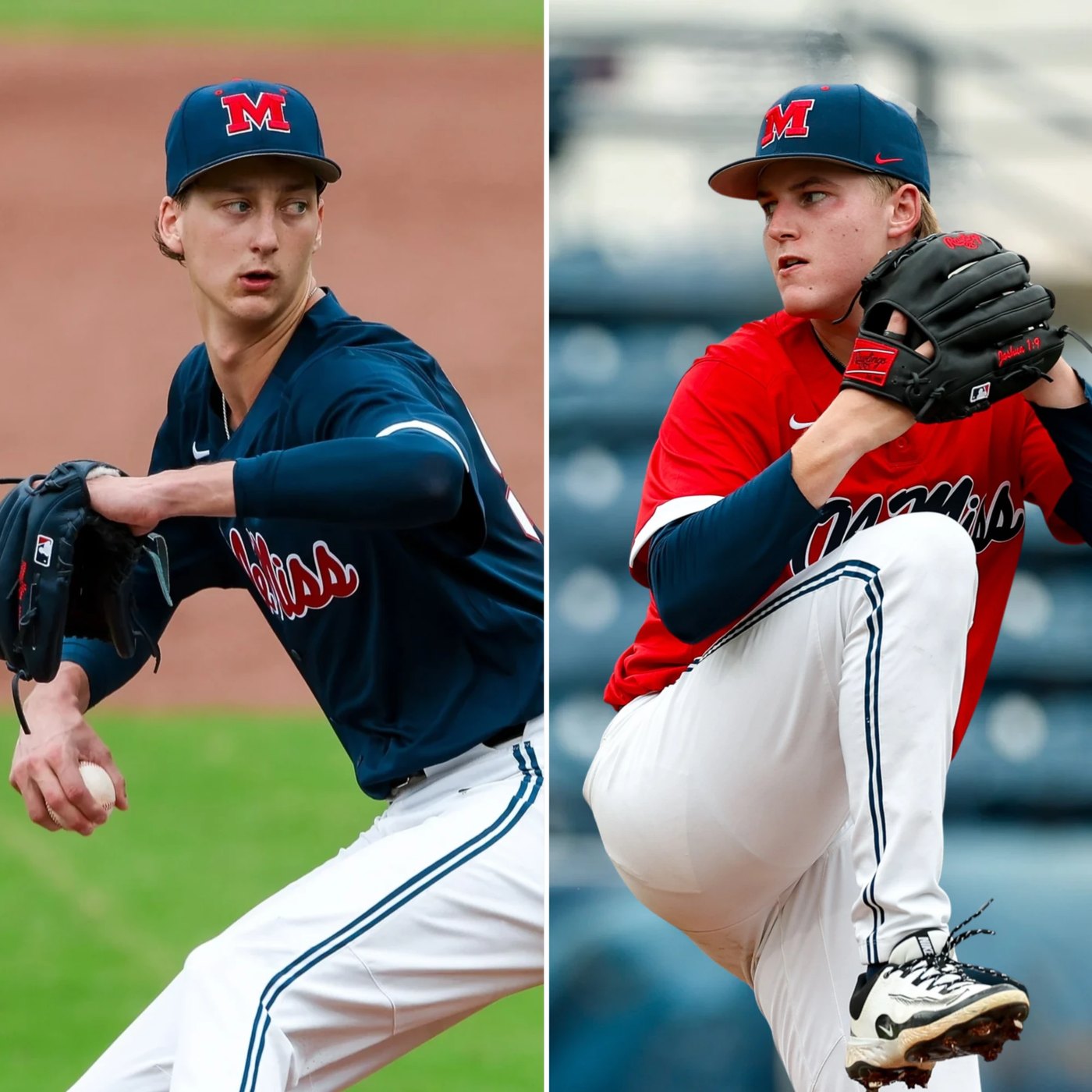
Ole Miss did something relatively unheard of in 2026. Two of its pitchers, both unranked or projected as Day 2 picks by most publications heading into the year, ended up becoming first-round selections.
Cade Townsend shot up draft boards after showcasing one of the deepest arsenals in college baseball, along with significantly improved command across the board. He would eventually be selected 23rd overall by the Cubs, signing for $3.1 million. That was far from what most people would have expected after watching him walk 13.1 percent of hitters while posting a 6.35 ERA in 2025.
You could argue that Taylor Rabe had an even more abrupt rise to college baseball fame. The 6-foot-5 right-hander surged up boards toward the end of the year after returning from injury and dominating opposing hitters. Rabe posted a 4.9% walk rate and showcased a fastball nearing triple digits. He would go on to hear his name called 30th overall by the Royals. Again, it was a relatively unexpected breakout from a guy who had thrown just 16 career collegiate innings entering 2026 and had previously struggled to miss bats.
Ole Miss has shown an ability to turn relatively overlooked arms into million-dollar success stories. This year, the Rebels attacked the transfer portal aggressively, bringing in a collection of pitchers with intriguing underlying metrics and plenty of low-hanging fruit to work with. There’s no guarantee they’ll be able to replicate the success of Townsend and Rabe, but based on early fall returns and a deeper look under the hood, two arms in particular stand out as breakout candidates.

Charlie Foster
Formerly a Mississippi State Bulldog, Foster has seen his fair share of ups and downs during his time in the SEC, posting a 5.48 ERA across 47.2 collegiate innings. He saw some time in the Bulldogs’ starting rotation in 2026 but struggled, ultimately transferring to Oxford with hopes of reclaiming a starting role in 2027.
Foster is well-built at 6-foot-4, with plenty of strength in his lower half, and told the Clarion Ledger he’s now up to 225 pounds after being listed at 205 at Mississippi State. He operates from a steep, over-the-top arm angle from the left side, with a release height of roughly 6.65 feet. Foster’s fastball sat in the 93-95 mph range for most of last year, touching 96 with some natural cutting action and an average of 19.5 inches of induced vertical break. While the pitch already looked above-average, reports out of Ole Miss’s fall camp suggest that Foster is now touching 99 mph following the added weight and some mechanical tweaks, which would make him one of the hardest-throwing left-handed pitchers in the country. Already a decent strike-thrower, Foster also appears to have sharpened his command. Ole Miss head coach Mike Bianco said Foster walked just two hitters across the entire fall while striking out 20.
Off the fastball, Foster has two potentially devastating secondary offerings. His changeup may already be a plus pitch, sitting in the 87-89 mph range with significant vertical separation off his fastball. The offering generated a whiff rate north of 40% last year, along with a chase rate above 37%, though it can get hit hard when left in the strike zone. The cutter is another offering that Stuff+ models should really like. It’s hard and tight in the 88-91 mph range, with sharp lateral break. Foster deploys it primarily against left-handed hitters. He’ll also mix in a big curveball, but for now, it primarily serves as a freeze pitch.
Given how good the stuff has looked and the apparent improvements he’s made, Foster may have a legitimate shot at claiming the Friday night role for Ole Miss. He’ll still need to carry the fall gains into the spring, but if everything comes together, the ceiling is that of a potential top-50 pick.

Kendall Hoffman
Hoffman transferred to Ole Miss following two solid seasons at the University of Houston, where he made 21 career starts and emerged as one of the better young arms in the Big 12. With north of 100 innings of college experience under his belt, Hoffman should be an intriguing option as a weekend starter for the Rebels.
Projection is the name of the game with Hoffman. While he has added weight over the past few years, at 6-foot-6 and 190 pounds, his frame still has plenty of room to hold additional muscle. As a guy whose fastball has already touched 97 mph, it’s easy to envision triple digits in the near future.
The biggest issue for Hoffman so far has been getting value out of his fastball. The pitch has somewhat of a dead-zone shape from a fairly standard release height, producing a single-digit whiff rate in 2026, while the average exit velocity against it ranked in the 6th percentile among D1 fastballs. While those numbers are certainly concerning, fastball quality is something Ole Miss has shown an ability to improve. In fact, Taylor Rabe’s improved fastball performance and velocity were among the biggest factors behind his success and rise up draft boards.
The rest of Hoffman’s arsenal is promising. He throws an 82-84 mph slider frequently with good biting action and above-average spin rates, as well as a tight 86-88 mph cutter, a combination he’ll favor against right-handed hitters. He’s also occasionally mixed in an upper-70s curveball, though he trended away from throwing it down the stretch last year. Hoffman’s changeup looks like a potential above-average or better pitch as well. He sells it with great arm speed and consistently creates tumble and heavy fade while killing spin on the offering. Hoffman also mixes in a sinker in the 92-94 mph range. It’s a relatively deep arsenal, and throwing strikes has been far from an issue for Hoffman. He boasted just a 5.4% walk rate in 2026, though his command could still use some further refinement.
Beyond what stands out about him as a pitcher, Hoffman also brings the kind of competitive mentality that Ole Miss has valued in its pitching staff. Rebels pitching coach Joel Mangrum even drew a comparison to Cade Townsend when discussing Hoffman in an interview about the incoming transfer class. “It’s Cade Townsend mentality. It’s one of the most competitive people you’ll ever be around. Hates to lose… I think he’s going to be one of the toughest freaking starting pitchers in the country,” Mangrum said.
There are still plenty of holes to fill in his game, but Hoffman has the upside to make a serious jump in 2027. Ole Miss will need to find a way to help him miss more bats, but if the pieces fall into place, Hoffman could emerge as one of the more intriguing draft-eligible arms to follow in the SEC this spring.