
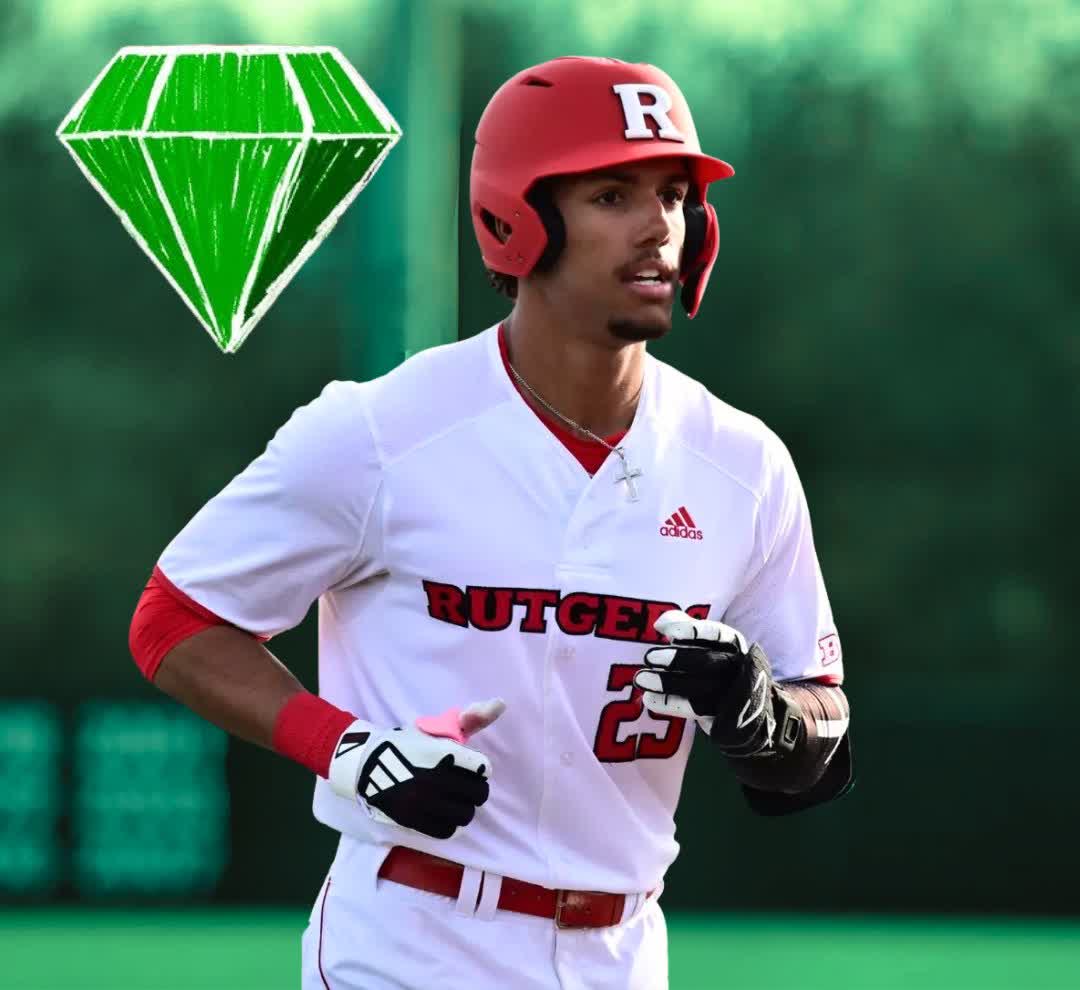
Plenty of pressure comes with having the name Bonds across the back of your jersey. It’s something Rutgers outfielder Peyton Bonds will likely carry for the rest of his playing career given that he’s the nephew of Barry Bonds, but Peyton has already started forging his own path. Those bloodlines are certainly a net positive, but even when you strip away the last name, the raw traits and tools present in his game are simply unteachable. They make him one of the more intriguing players in this draft class and someone who could make serious waves if the right organization calls his name on July 11th.
A quick glance at the slash line may leave you a bit disappointed. Bonds is a career .305 hitter across his 3 years at Campbell and Rutgers, and only has 16 home runs. The production has been a bit underwhelming up to this point in time, and while Bonds’s .352/.436/.535 slash from 2026 was the best of his career, he had trouble staying on the field for a full season.
Given the relatively average surface numbers, what makes Bonds such an intriguing prospect? Well, most people will probably point you to the fact that when he squares a ball up, it’s some of the best raw power in all of college baseball. Bonds picked up some serious traction on baseball social media back in March when he hit a ball 121 mph in a Saturday game against Illinois. It’s one of the hardest balls a college baseball player has hit in the Trackman era.
The 70-grade or better raw power isn’t eye-wash, Bonds put on an absolute showcase at the MLB Draft Combine, showing off easy feel for launch to the pull-side with multiple balls hit over 110 mph and a max exit velocity of 113 mph with wood. At 6-foot-5 230 pounds, Bonds looks like a titan in the box, with impressive raw bat speed to match the physicality.
Bonds isn’t just a physical specimen. The bat-to-ball skills and adjustability he shows for someone with his size and levers is frankly rare. Bonds maintained a contact rate of roughly 81% throughout the 2026 season. His ability to make contact, especially on pitches outside the zone, is pretty remarkable. Even while chasing pitches outside of the zone more than 38% of the time with a swing rate north of 50%, Bonds held a strikeout rate hovering just a shade above 15% in 2026.
So what story does this tell? Bonds is extremely gifted from a hand-eye coordination standpoint, but he’s also a remarkably, remarkably aggressive hitter. Bonds has boasted a sub 10% walk rate in every single year of his collegiate career, with an xBB% in the 2nd percentile for all NCAA hitters in 2026. Poor swing decisions have completely hindered his ability to walk, at any sort of high clip.
The ability to get on base isn’t just the only thing poor swing decisions have hurt for Bonds. It’s also severely hampered his contact quality. For a guy with Bonds’s raw power, you’d expect better numbers in-terms of his expected outcomes. Bonds’s xwOBACON in 2026 was .424, that is in the 70th percentile for all college hitters. For reference, Cal State Northridge outfielder Matthew Thomas, who has a similar 90th percentile exit velocity to Bonds, had an xwOBACON more than .200 points higher, putting him in the 99th percentile. That is a drastic difference. Bonds has to improve the quality of the batted balls that he is putting in play.
So what does this entail? You have to teach Bonds to swing at the right pitches. He has to swing at pitches that he can get his barrel on, and he has to get the baseball in the air. It’s a tall task for a player development system, but one that can be done, especially when considering what Bonds already does well.
Bat taken away, Bonds moves surprisingly well for someone with a 6-foot-5, 230 pound frame. He’s an above-average runner with above-average arm strength who may legitimately get a chance to start pro ball in center field. He will likely settle into a right-field role as he continues to mature, but the athleticism is impressive at this stage. He could ultimately steal 20+ bags at the next level given what we’ve seen in college.
When looking at the raw traits on paper, everything is there. Bonds has double-plus raw power, and unlike most with that type of juice, his hand-eye coordination stands out. Heck, he’s even got sneaky athleticism and some tools in the outfield. If you throw him into the right player development system, the final form could be scary. The pieces haven’t fully aligned yet, but they could. The ceiling is an All Star caliber player.
In the 2nd to 3rd round range where Bonds will likely go, taking a player with a rawer all-around profile and a just alright track-record of college performance is a little easier to swallow, even easier if you have a player development system you can trust. With Rutgers outfielder Peyton Bonds, that’s a no-doubt shot worth taking.